
For over a decade, the biggest barrier to cryptocurrency adoption has been the user experience (UX). To use a decentralized application, a user currently has to manage a seed phrase (a list of 12-24 words), pay “gas fees” in a specific native token (like ETH), and sign cryptic transactions. If they lose their seed phrase, their money is gone forever. This “self-custody” model is powerful but terrifying for the average person. The solution that is finally arriving in 2025 is “Account Abstraction” (specifically the ERC-4337 standard on Ethereum), a technology that promises to make the friction of crypto disappear.
Smart Accounts vs. Externally Owned Accounts
Currently, most crypto wallets are “Externally Owned Accounts” (EOAs). They are dumb key-pairs that can only do one thing: sign transactions. Account Abstraction upgrades these to “Smart Accounts.” A Smart Account is essentially a smart contract that lives on the blockchain but acts like a wallet. Because it is programmable code, it can do things that a traditional private key cannot.
The Benefits: Social Recovery and Gas Sponsorship
The features unlocked by Account Abstraction are game-changing for UX:
- Social Recovery: No more seed phrases. If you lose access to your wallet, you can regain it through a pre-approved group of “guardians” (e.g., your spouse, your lawyer, and a hardware device). This mimics the “forgot password” flow of Web2.
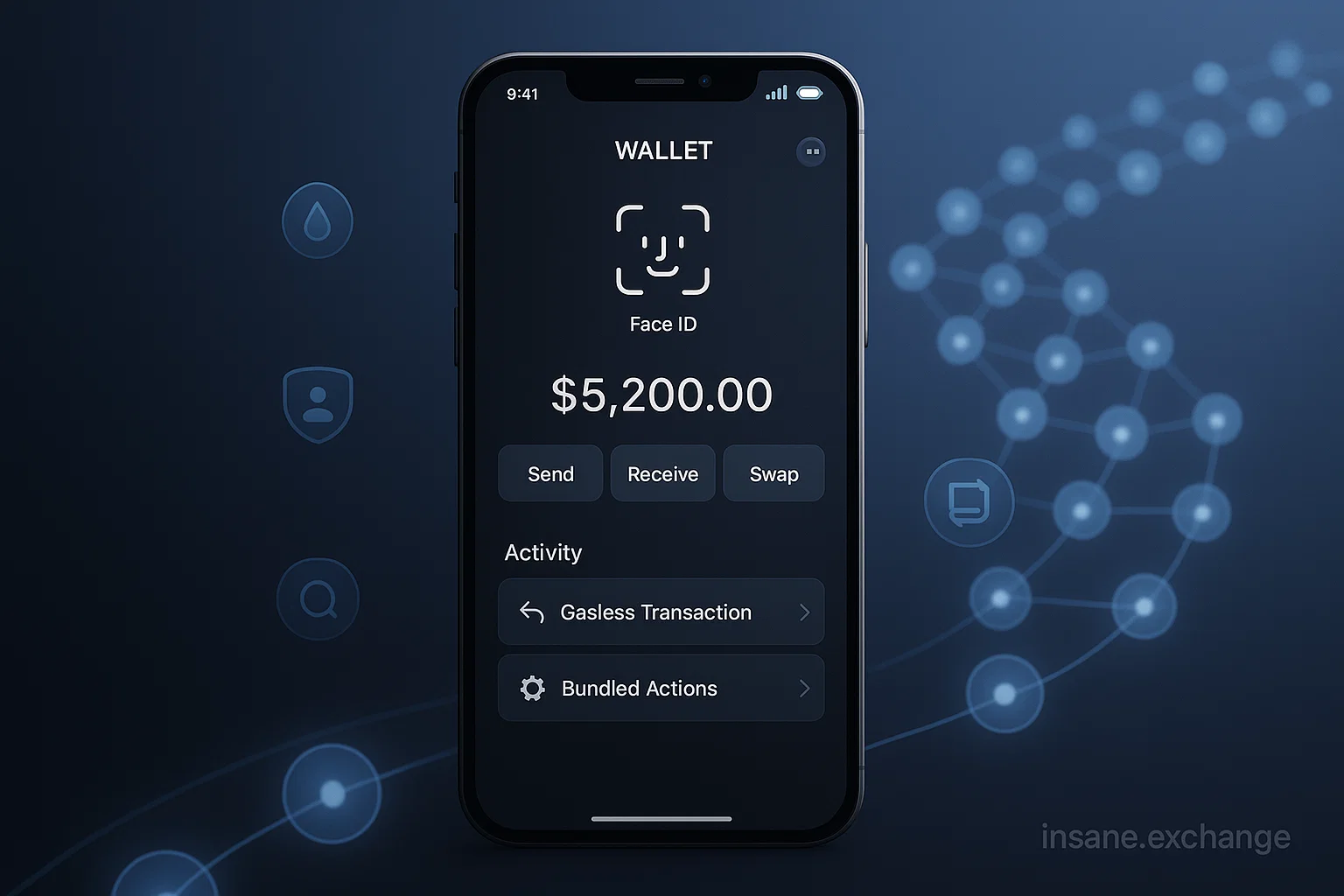
- Gas Sponsorship: Currently, you need ETH to pay for gas on Ethereum. With Smart Accounts, an application (dApp) can pay the gas fees for you, or you can pay gas fees in any token (like USDC). This means a user can interact with a blockchain app without ever owning the volatile native token.
- Bundled Transactions: Instead of signing three different pop-ups to complete a trade (Approve, Deposit, Stake), a Smart Account can bundle these into a single click.
The “FaceID” Moment for Web3
Just as biometric login revolutionized mobile banking, Account Abstraction allows for features like signing transactions with your iPhone’s FaceID or a fingerprint scanner. It turns the crypto wallet into something that feels like a standard fintech app. This technology is critical for onboarding the next billion users who will never write down a seed phrase on a piece of paper.
The Bridge Between Centralized and Decentralized
Account Abstraction blurs the line between the ease of a centralized exchange and the security of self-custody. It allows for “non-custodial” wallets that feel “custodial” in terms of ease of use. As this technology rolls out, we will see a new generation of hybrid platforms. For now, users navigating this transition often rely on versatile brokerages that offer different tiers of access.
The YWO trading platform, with its various account types, is positioned to serve users across this spectrum, from those who want full traditional custody to those exploring these new on-chain paradigms.

Numbers Gordon is a young, creative mind that has a knack for working with numbers. After discovering her love for cryptoartworks in college, she has made it her life's mission to create experimental and innovative art pieces that push the boundaries of what is possible. She is 30 years old and resides in the city of Los Angeles.